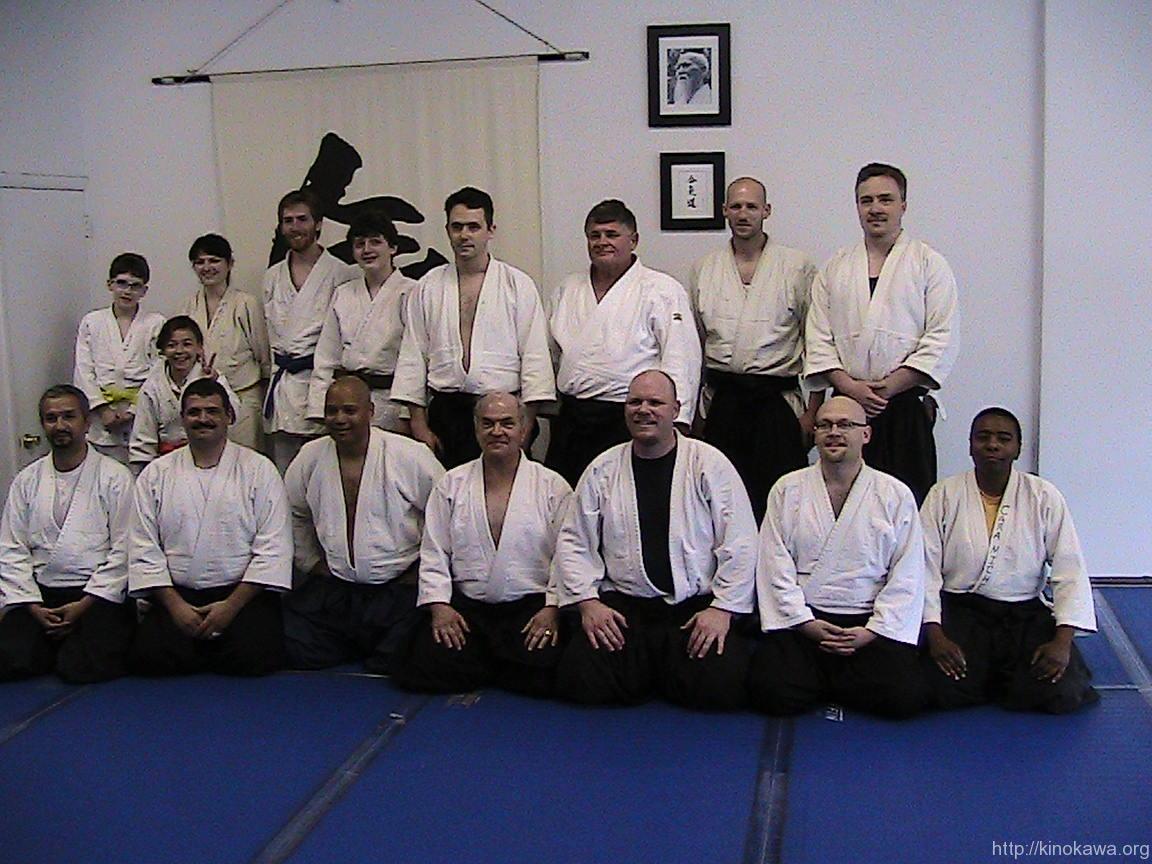

Kinokawa ryu is a form of Aikido that emphasizes the unconditional acceptance and blending of energy (Ki). Its focus is to achieve the unification of mind, body and spirit into one movement with total concentration and purpose.
Kinokawa means "River of ki" or " River of spirit". Kinokawa ryu, unlike other forms of Aikido, believes in the realistic application of Aikido as a martial art and as a path for spiritual growth. In addition, Kinokawa ryu practitioners believe and follow the "Five Principles of Aikido" as taught by O'Sensei and the "Four Principles to Unify Mind and Body" as taught by Koichi Tohei.
Mind and body were originally one. Do not think that the physical power you have is the only power you ordinarily use to live and grow. The power you ordinarily use is like the small, visible segment of an iceberg. When we unify our mind and body and become one with the universe, we can use the great power that is naturally ours.
My Aikido training began in Sensei Maruyama's Arch St. Dojo in April, 1972. I was then a young man of 24 with some Tae Kwon Do training (from S. Henry Chi, in Manhattan) and many street fights in my past. The grace and power I witnessed in those first few hours at the Dojo drew me into the way of Aikido.
In those early days we spoke little and trained very hard. There were only a few students who endured for long.
Maruyama Sensei was a student of Koichi Tohei Sensei and O'Sensei. By 1971, two years after O'Sensei's death, divisions of viewpoint regarding who was to lead Aikido and how it was to be conveyed and directed lead to a split between Tohei and Kisshomaru Ueshiba, the Founder's son. Maruyama Sensei aligned himself with Sensei Tohei, and so it was that our practice in the 1970's reflected both the early style and training of O"Sensei as preserved and conveyed by Aikikai and the flowing late life Aikido of O'Sensei presented by Tohei.
In 1980 Sensei Maruyama moved to Nagoya Japan, leaving senior students to run his two Philadelphia Dojos. The next few years brought a slow but steady growth to these schools and the blossoming of a division between Tohei and Maruyama. By 1985, these two extraordinary men were no longer working together.
Maruyama founded Kokikai as a vehicle for Aikido fundamentally and stylistically true to Tohei's. As Kokikai continued to grow, I opened Kokikai dojos in Reading, Pottstown, and Norristown. During this time, differences between Sensei Maruyama's Kokikai, and my style were becoming apparent. By 1991, my schools were operating independently from the Kokikai organization, and they were given the name Kinokawa.
Bushido encompasses a system of moral principles. It embodies a code of daily living for the samurai. Those instructed in the code are expected to discipline themselves according to it. The seven principles of budo are: